
 |
Alan Turing: the EnigmaNotes by the author, Andrew HodgesHome Page | Site Map | Contact and FAQ |
R E V I E W SThe centenary edition, 2012Turing's rehabilitation from over a quarter-century's embarrassed silence was largely the result of Andrew Hodges's superb biography, Alan Turing: the Enigma (1983; reissued with a new introduction in 2012). Hodges examined available primary sources and interviewed surviving witnesses to elucidate Turing's multiple dimensions. A mathematician, Hodges ably explained Turing's intellectual accomplishments with insight, and situated them within their wider historical contexts. He also empathetically explored the centrality of Turing's sexual identity to his thought and life in a persuasive rather than reductive way... One welcome output of the Turing industry is a reissue of the definitive biography by Andrew Hodges. In the complex process of Turing's re-evaluation, Hodges stands out as both agent and chronicler: his concluding 'author's note' ... is an impressive historiographic essay, critically surveying Turing's reputation up to the time of the book's first publication in 1983. As in the previous reissue of 1992, the original text appears unrevised with a new preface; where the emphasis in 1992 was on presenting newly discovered sources, however, Hodges here works mainly to assimilate the scope and consequences of his own success. To insist on appreciating Turing as 'a figure in world history' ... might have seemed grandiose in 1983; today, the position is mainstream... This long and serious review of 'Turing Today' comes from a deeply informed History of Science perspective, notable in studying the enormous shifts in opinion that have taken place both before and after 1983. Andrew Hodges' 1983 book "Alan Turing: The Enigma," is the indispensable guide to Turing's life and work and one of the finest biographies of a scientific genius ever written. On the face of it, a richly detailed 500-page biography of a mathematical genius and analysis of his ideas, might seem a daunting proposition. But fellow mathematician and author Hodges has acutely clear and often extremely moving insight into the humanity behind the leaping genius that helped to crack the Germans' Enigma codes during World War II and bring about the dawn of the computer age... Then suddenly, in 1983, Andrew Hodges published his biography, Alan Turing: The Enigma, which told it all. It finally brought Turing the man into sharp focus... He got the full story and told it carefully, intimately, and well. And he brings it up-to-date in the Centenary Edition. It's still the Bible of Turing biography. Essential in 2009One of 'Ten essential books on technology', chosen by John Ridpath in the New Statesman, 4 May 2009.Essential in 2006Two decades ago, a mathematician named Andrew Hodges published 'Alan Turing: The Enigma', which is one of the finest scientific biographies ever written, and has remained an essential resource for all subsequent accounts of Turing's life. Essential Book for 2002Listed as one of the essential 50 books of all time in the The Guardian, 1 June 2002.Comment in 2000I was fortunate to have available Andrew Hodges's poignant, beautifully written biography of Turing. One of the finest scientific biographies I've ever read: authoritative, superbly researched, deeply sympathetic and beautifully told. A captivating, compassionate portrait of a first-rate scientist who gave so much to a world that in the end cruelly rejected him. Perceptive and absorbing, Andrew Hodges's book is scientific biography at its best. Comment in November 1997'I wish I'd written,' by Ray MonkRay Monk is biographer of Wittgenstein, Bertrand Russell and Robert Oppenheimer. His column in the series 'I wish I'd written' appeared in The Guardian on 13 November 1997:There are many things I wish I could write, but realise I never will: poetry, drama, travelogues, situation comedies, to mention but a few. But a book I wish I had written, and one that was a big inspiration for the things I have written, is Alan Turing: the Enigma by Andrew Hodges. I read it when it first came out in 1983, and immediately formed the ambition to write something similar about Ludwig Wittgenstein. Desert Island Book Choice by Margaret BodenProf. Margaret Boden, asked by the New Scientist to choose just one book for its edition of 22 November 1997, wrote:My choice is the biography Alan Turing... by Andrew Hodges. This superb biography satisfies many of the intellectual senses. Written by a mathematician, it describes in plain language Turing's work on the foundations of computer science and how he broke the Germans' Enigma code in the Second World War. The subtle depiction of class rivalries, personal relationships, and Turing's tragic end are worthy of a novel. But this was a real person. Hodges describes the man, and the science that fascinated him — which once saved, and still influences, our lives. Some reviews of the original publicationThis book is a first-rate presentation of the life of a first-rate scientific mind... it is hard to imagine a more thoughtful and warm biography than this one. Douglas Hofstader, then known as the author of Gödel, Escher, Bach (1979), was of great importance in attracting attention to Alan Turing: the Enigma when it was first published. His essay-review was later included in Metamagical Themas, and then reprinted as a Foreword to the 2014 editions of my book. It is a first-class contribution to history and an exemplary work of biography. I. J. (Jack) Good was a wartime and post-war colleague of Alan Turing, a distinguished statistician, and an important figure in my book. Andrew Hodges's book is of exemplary scholarship and sympathy. Intimate, perceptive and insightful, it's also the most readable biography I've picked up in some time. ... the first serious synthesis of mathematical and gay liberationist insight... a new standard in writing about gay people in the past. It is the moving story of a man with a brilliant mind, who refused to deny his feelings, in a search to understand — and live — true life. 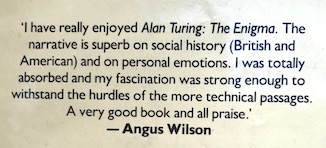 This pre-publication commendation appeared on the cover of the original UK edition. Angus Wilson knew Alan Turing, who eagerly read his 1952 novel Hemlock and After. |
Alan Turing: the Enigma | Reviews | Arts and Media |
 Home Page |
 My Publications |  Turing Sources |
 Scrapbook |
| Website © Andrew Hodges | Contact, copyright, FAQ | ||